

Colonial Switzerland: Rethinking Colonialism from the Margins published in 2015
The researchers’ book, titled Colonial Switzerland: Rethinking Colonialism from the Margins, highlights key points, such as the involvement of “non-colonial” countries like Switzerland in colonial history over the past centuries, as well as their role in today’s “colonial imaginary.” This, in turn, leads to a present-day confusion between history and collective memory, which shapes Swiss national narratives and the social issues facing contemporary Swiss society. This emphasis is partially achieved through an analysis of the “Margins of Colonialism”, a new and innovative way of approaching post-colonial studies to better understand the underlying issues raised by the question of colonialism. Indeed, defining this notion is complex and cannot only be explained through the administration of foreign territories as the French and British did for example, but it is also subtler than that.
Analysing the margins of colonialism can help in this context by studying broader fields more indirectly linked to colonialism, as illustrated by the examples above. An important part of this aspect is also dedicated to “(Post)colonial Self-Representations” and Switzerland’s role in their developments. The authors cite several works, including those by Angela Sanders and Rohit Jain, to support these perspectives.
The initial example of James Baldwin’s visit to Leukerbad, a small Swiss village where he was the first Black man the villagers had ever encountered, highlights one of these main notions described by Purtschert and Fischer-Tiné: the idea of a double standard or consciousness used or implemented in Switzerland regarding its own colonial history. On the one hand, there is the traditional promotion of the country’s neutrality in international affairs including a colonial-free image and its alleged non-implication in colonialism throughout history, while on the other hand, maintaining xenophobic and racist ideologies within Switzerland’s borders and through its foreign policies. The country then justifies or has justified, its own actions by resorting “to the trope of colonial innocence” asserting that its ideologies cannot be problematic “since Switzerland never had colonies!”. The black sheep’s campaign from the SVP/UDC political party or massive investments in South Africa under the Apartheid regime constitute examples to illustrate this contradiction. These examples shed light on the first area of the margins of colonialism as described in the book’s introduction which consists of the “issue of the actual significance of colonialism for the respective country” (Switzerland here).
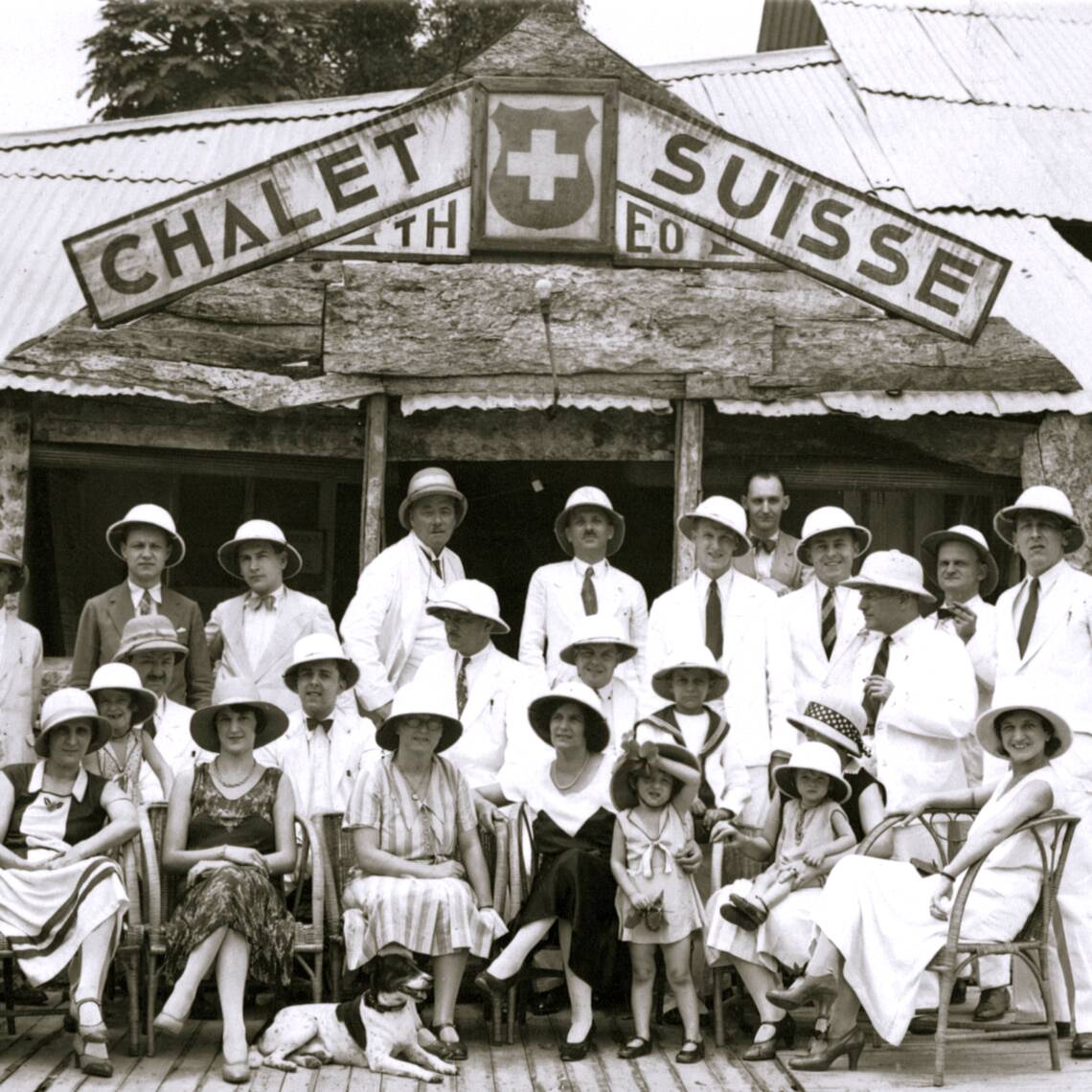
Swiss missionaries in front of an improvised “Chalet Suisse” wearing the colonial helmet (Schweizerisches National Museum)
To better understand Switzerland’s actions in a colonial context, the authors suggest so
to “transgress a narrow national framework” which means to analyse Switzerland’s involvements in colonialism through other ways than directly administering colonies. We could
think of imposing European languages or knowledge into other countries’ colonies for instance. This aspect of “soft power” impacting native societies is crucial for deconstructing the traditional and naïve narrative that views Switzerland as a peaceful nation that took no advantage of colonialism in its history. Finally, these two notions of “double consciousness” within the “margins of colonialism” and transgression of “narrow national framework” as already mentioned are central in this introduction and represent two main concepts unveiling issues and methods to better understand some darker sides of Switzerland’s history.
If you are interested in this subject, the Swiss National Museum in Zürich is holding an exhibition on Switzerland’s involvement in colonialism from September 13, 2024, to January 19, 2025.

Cliquez sur la photo pour plus d’articles !
Sources:
Purtschert, Patricia, and Harald Fischer-Tiné. Colonial Switzerland: Rethinking Colonialism from the Margins. Basingstoke: Palgrave Macmillan, 2015.
Landesmuseum Zürich, « Kolonialismus, » accessed November 1, 2024