
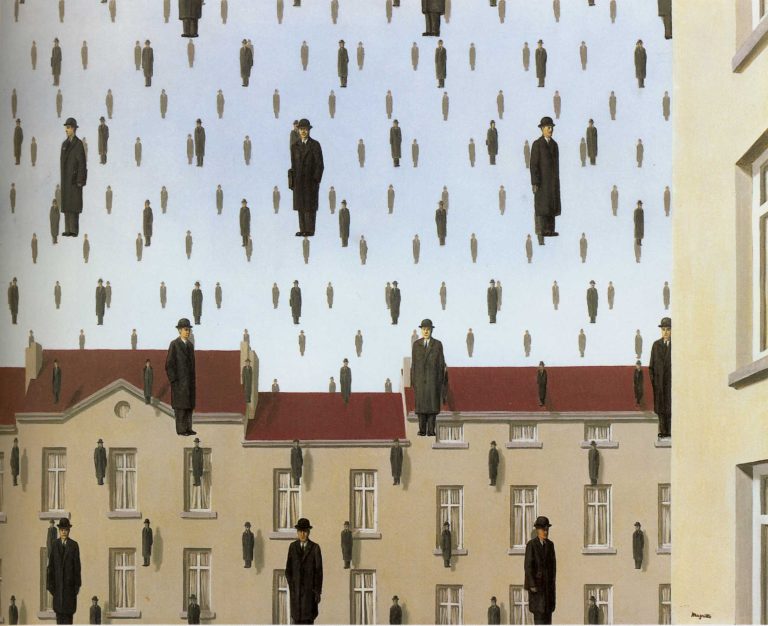

American universities have recently made headlines following the Trump administration’s decision to exert heavy state influence over schools. The most famous case is Harvard University, that went to court against the United States administration after the state cut them off $9 billion in funds. Other important universities such as Brown, Columbia, Cornell, Duke, Northwestern, Penn, Princeton, and the University of California have all received strict orders from the country’s administration, which argues that the schools are enforcing ideological biases. Multiple claims have been made about how these threats to elite universities directly impact the academic freedom of the institutions and the students.
This American war on universities is not a simple headline from a sudden presidential decision; it is a symptom of a long process leading to an established scepticism that pushed fear towards intellectualism: The post-truth era. This article aims to analyse this concept and understand how the American public was prompted towards opinion-based realities, leading to anti-intellectualism that discredits higher educational institutions and science. The present circumstances represent a larger attack on fact-based research affecting not only the United States but the world.
What is the post-truth era?
The term “post-truth” has been most used since 2010 and especially 2016 when it was highlighted as the word of the year by the Oxford English Dictionary. While the term has been defined from multiple perspectives, particularly through the political landscape, the Cambridge Dictionary entry defines it as : “relating to a situation in which people are more likely to accept an argument based on their emotions and beliefs, rather than one based on facts.” The use of the term “post-truth era” refers then to the period in which data-driven facts are abandoned for opinion.
Research director at the French National Centre for Scientific Research (CNRS) Ran Halévi offers multiple factors characteristic of a post-truth era. First, the discrediting of central institutions providing information, such as experts, political parties, and traditional media, that no longer transmit any sense of legitimacy in front of public opinion. Second, the existence of “partisan media” in social media networks that enclose the audience in communitarianism that limits to a single worldview what is considered the truth.
Social Media’s Role
Indeed, social media represents a main pillar for the post-truth era. Charles Mercier, Jean-Philippe Warren and Régis Malet in Post-vérité : la crédibilité du discours scientifique à l’heure des “faits alternatifs” emphasize how a “mediatic revolution” took place and set aside traditional outlets (such as newspapers, television networks, radio…) in favour of “new media” (such as YouTube, Instagram, TikTok, Podcasts). The latter is a more than fertile ground for the post-truth era as it relies heavily on reactivity and emotional responses instead of rational thinking. As Mercier, Warren and Malet advance, the problem lies in the fact that around 40% of the information available online is considered fake news and 60% is generated by machines. The consumers are thus highly stimulated with an enormous amount of both fake and research-based information. This continuous stimulus creates a form informational fatigue that prevents complex thinking. In this state, the consumers become more vulnerable to stereotypes and intellectual shortcuts that please their cognitive biases. Finally, the complete shutdown of critical thinking resides in the creation of a self-referential universe. The latter, only accessible for same-view consumers, forms a community that keeps further reinforcing their self-created version of reality.
This informational fatigue is a clear contribution to the post-truth era, but it does not explain unwillingness to believe in proven facts. If we take the example of climate change scepticism, why does science denial persist even when the evidence of its reality is clear and understood?
The Comforting Lies
“Speech is a powerful lord, which by means of the finest and most invisible body effects the divinest works: it can stop fear and banish grief and create joy and nurture pity.”
Gorgias, Encomium of Helen
2,500 years ago, the sophist philosopher Gorgias had already understood the importance of speech for our emotional state. Speech is performative; it has the power to shape a preferred version of reality that influences our emotions. Continuing with the example of climate change scepticism: Why would someone want to fear the climatic destruction of our world when they can simply use speech to refuse its existence and “stop fear . . . banish grief and create joy”? If a consumer of information ignores the proven negative consequences of carbon emissions, the world starts to fit their ideal version of reality. This denial is cemented when a collective ethos is formed around the subject. This refusal around factual evidence is all the more easily dismantled when the subject is a larger abstract concept such as the pandemic and climate change. Speech becomes more powerful in that situation because deniers will equate their own speech to the speech of experts. They follow the logic that speech is speech, even when one is based on opinion and the other on scientifically proven data.
The Power That Lies within Lies
Mark Lilla, professor of humanities at Columbia University in New York, develops how beyond looking for comfort in themselves, the consumers in chosen denial want to hold the power of controlling the truth. He argues how sceptics instinctively reject objective truth because they represent an “undemocratic imposition.” The consumer had no say in the existence of climate change, so why should it exist? Here, truth becomes an expression of power instead of an undisputed reality.
Within the political landscape, seeing truth as power means that political success can only be achieved when truth is on the side of the politicians. The problem is that when the truth does not correspond to their opinion on reality, they must refute any truth coming from any other source of information, such as traditional media or scholars. Consequently, going against the scientific consensus and giving a “better” version of reality both give power to the speaker and comforts the consumer. This process becomes dangerous for a democracy as it implies an erosion of the factual consensus in public discourse in favour of an opinion-based system. The discrediting of intellectuals occurs as a response to their evidence-based information that may contradict the emotion-based opinions. That is when anti-intellectualism is pushed forward.
The Erosion of Factual Consensus and the Rise of Anti-Intellectualism
A post-truth era feeds itself on anti-intellectualism which can be defined as the “refusal to recognise the pre-eminence of intelligence and the value of science.” The COVID-19 crisis offered the perfect example of the development of anti-intellectualism fuelling our post-truth era. Part of the population did not want to be limited by the reality of the pandemic, resulting in heavy criticism regarding scientific experts and the development of an alternative discourse on reality. Becoming an anti-vaxxer was a refusal of the decisional power held by experts.
Sociologist Aziz Jellab argues how the opinion-based individual retrogrades the expert as being too far from their reality, again favouring their personal experience over data-driven facts. A distinction is created between “real people” and “elitist” intellectuals that start to differentiate themselves from opinion-based individuals, further participating in the division.
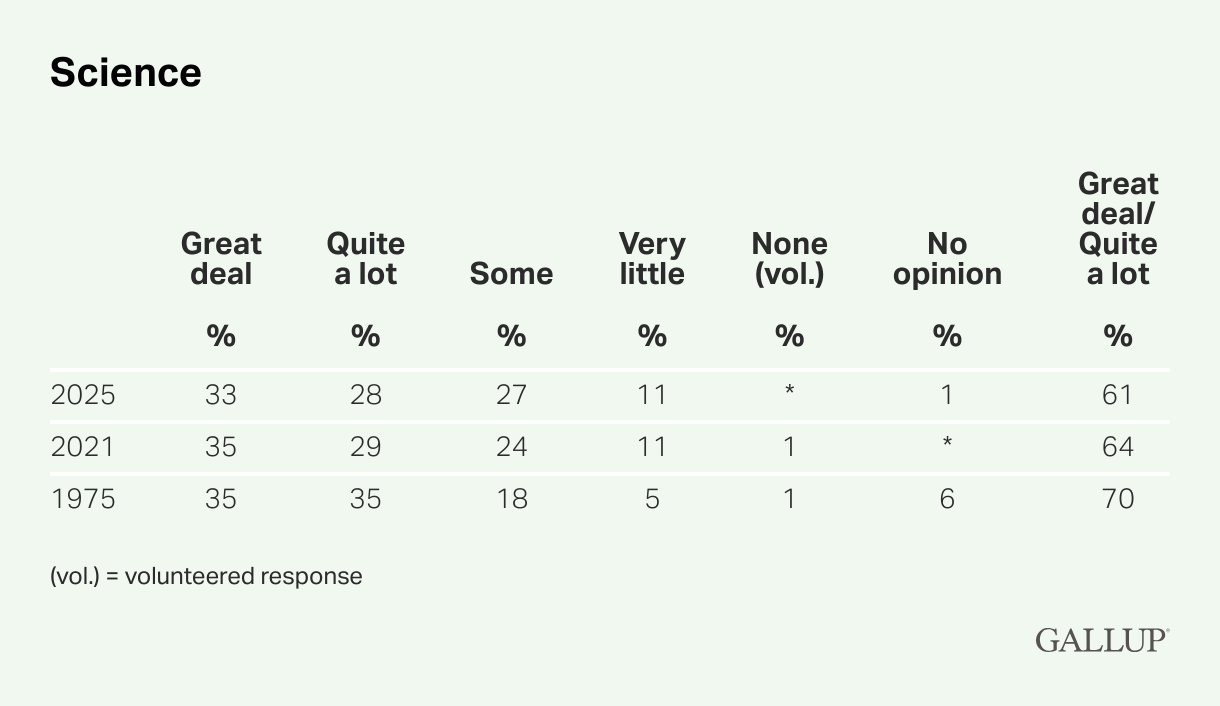
As the following table suggests, a clear trend of loss of trust in science can be observed since 1975. Between 2021 and 2025, a 3% loss of people believing in science a “Great deal/ Quite a lot” can be remarked, which might be linked to the COVID-19 pandemic. The latter showcasing a clear recent trend in the rise of anti-intellectualism.
The Consequences of Post-Truth and Anti-Intellectualism
The development of post-truth and anti-intellectualism launches a war on institutions that provide empirical, evidence-based methods instead of opinion-driven claims. The more versions of the truth are discredited, the more subjective ones become “real”.
As previously presented, American universities’ academic freedom is being attacked and delegitimized through accusations of ideological bias. This discrediting affects more than universities; it is a general threat to any science-based institution. In March 2025, 1,000 people warned about layoffs of around 800 workers at the National Oceanic and Atmospheric Administration (NOAA). The employees were scientific experts responsible for climate and ocean analysis. The same situation happened in the National Aeronautics and Space Administration (NASA) and the National Institutes of Health (NIH) who endured redundancies and budget cuts. These are the real-life consequences of pushing forward anti-intellectualism feeding the post-truth era.
Although this threat might seem limited to the United States, it has global implications. In March 2025, the Trump administration undermined the value of the World Health Organization (WHO) by deciding to delay the sharing of the United States data about the influenza virus. This decision impacts both the accuracy of the American vaccines and the world’s public health control of pandemics. Further, the American medical committee was prohibited from holding any meeting with the aim of creating a flu vaccine. This comes as no surprise as the United States Secretary of State for Health, Robert F. Kennedy Jr., is a notorious anti-intellectualist who does not believe in vaccines.
Scientists around the world have reacted to the anti-intellectual actions in the United States, all the more after the mass redundancies and budget cuts in the country’s universities. Demonstrations under the slogan “Stand up for Science” have erupted, including in the UNIL campus where a group of researchers from UNIL and EPFL gathered in March 2025 in solidarity for the “researchers from other countries who are persecuted or prevented from doing their work because of its content,” as quoted by the RTS.
Conclusion
The U.S. vs. Harvard court battle is not merely a political dispute over funding or ideology. It is a surface-level story hiding a larger war against evidence-based truth. The problem is not questioning institutions, politicians, nor media, but it is questioning the world’s physical, biological, and social facts. There is the entryway to nihilism and the loss of democracy as we institutionalize lying. Favouring opinions would cost us reality.
To counter post-truth, critical thinking alone seems too weak. To quote Sibel Erduran, Professor of Science Education at the University of Oxford, it would take society even more effort to challenge this problematic. She argues that “Post-truth demands a cultural shift in science education to ensure that sociological and political contexts of science are explicitly taught and understood.” The answer remains in our own hands; shall we fight for the truth? But what if our truth is the wrong one?
Carolina Silva Pereira
Sources
- Article source file: https://docs.google.com/document/d/1BS_6z-tWEDSgdblIkGSTxe5-MGk7h2aTcPK4cLxm-Gc/edit?usp=sharing
Similar articles:

Media Access Change in the White House: A New Political Media Landscape

Why online fake news threatens democracy and how rational citizens can recognize and combat it
