
The analysis is divided into two parts. First, a descriptive overview shows temporal rhythms, recurring hotspots, and the long-run evolution of reported accidents. Second, a set of non-parametric and count-based statistical tests explores whether accident distributions and severity differ between vehicle groups over time. It is important for me to note that this is not a safety ranking of Geneva’s public transport system. Rather, it is an empirical look at how incidents are distributed across a decade of urban mobility change.
TPG Open Data
For the analysis I used the open data published by Transports publics genevois (TPG) [1] that covers reported operational events in the Geneva public transport network from 2015 until today. For this study, I limited the dataset to accidents only and to the period 2015 to2025, excluding the incomplete current year 2026. The key variables used in the analysis are:
- Date and hour (Jour & Heure)
- Line and stop (Ligne & Arrêt)
- Severity indicator (Indicateur de Sévérité)
- Human injury level and material exploitation impact
- Vehicle category (used to classify into dummies):
- Electric fixed-infrastructure vehicles: tramway, trolleybus
- Bus-based vehicles: autobus noctambus, autobus principal, autobus regional, autobus secondaire, glct, scolaire
- Ambiguous or special-purpose categories such as autres, notfound, manifestations, personnel, and event-specific services were excluded.
- Electric fixed-infrastructure vehicles: tramway, trolleybus
Empirical Approach
To examine accident patterns in Geneva’s public transport network, I combine descriptive statistics with a small set of inferential methods that are appropriate for the available data. Open data may be irregular over time, might be skewed, and might not well suited to strong distributional assumptions. For this reason, I use methods that remain interpretable while evading model complexity. The results of the study are split into two parts. The first one presents a descriptive statistical overview.
The inferential part of the analysis focuses on a narrower question: whether accident patterns differ systematically between electric fixed-infrastructure vehicles and bus-based vehicles. To test whether the composition of accidents changed over time, I use a chi-square test of independence on a contingency table that compares accident counts across three periods: 2015-2019, 2020-2022, and 2023-2025. The chi-square test is appropriate here because it evaluates whether the relative distribution of accidents across the two vehicle groups remains stable across periods or changes in a statistically meaningful way.
Moreover, I estimate a Poisson regression model for monthly accident counts. Count data are naturally modeled in this structure because the dependent variable records the number of accidents observed in a given month. The model relates monthly accident counts to vehicle group while controlling seasonality and for long-run change. Essentially, this allows me to assess whether one group is associated with systematically higher or lower reported monthly accident counts over the decade, while accounting for recurring seasonal patterns and gradual changes in the network.
An author’s note here: these methods do not establish causality. Rather, they provide a structured way to describe how accident patterns evolved over time and to test whether the differences observed between service groups are statistically meaningful.
Results
Accidents per Hour
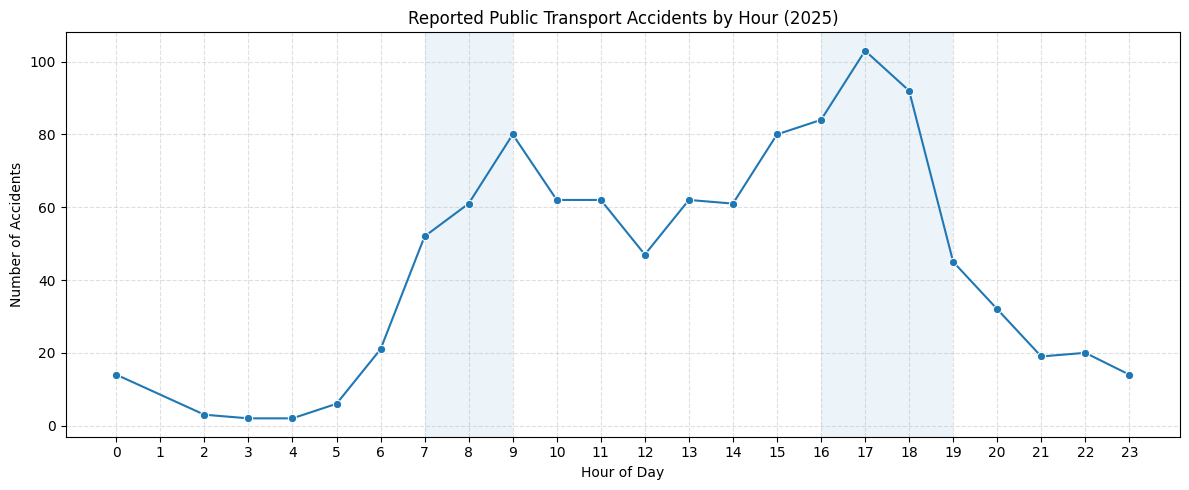
The hourly distribution provides a first operational fingerprint of the network. As expected for a dense urban system, accidents are not evenly distributed across the day. Instead, they cluster around the periods of greatest service intensity, with visible peaks likely aligned with commuter demand and network congestion. The chart suggests that accident frequency is tied less to clock time itself than to the rhythms of urban movement: the morning rush to work, the daytime siesta-time, and the evening rush back home.
Accidents Hotspots
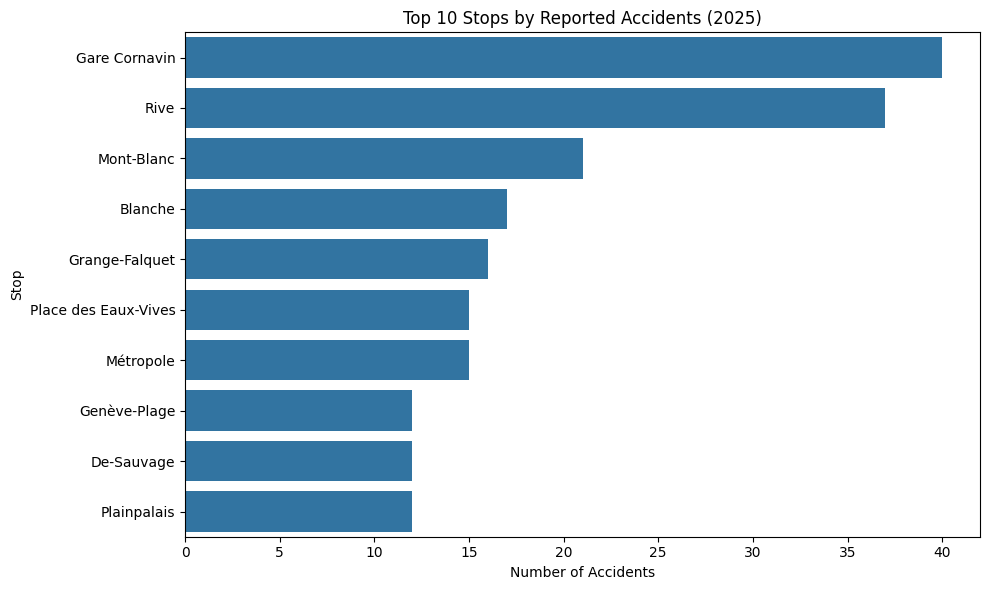
Concentration appears at the stop (arrêt) level. These ‘top 10’ hotspots are likely not “dangerous” in an absolute sense, but they do appear to function as logistical pressure points as they depict interchanges, heavily used boarding points, or locations with difficult traffic interfaces. Anyone who has ever been to Gare Cornavin will not be surprised to see this station to be on rank 1.
Long-run Evolution – 10 years of accident data
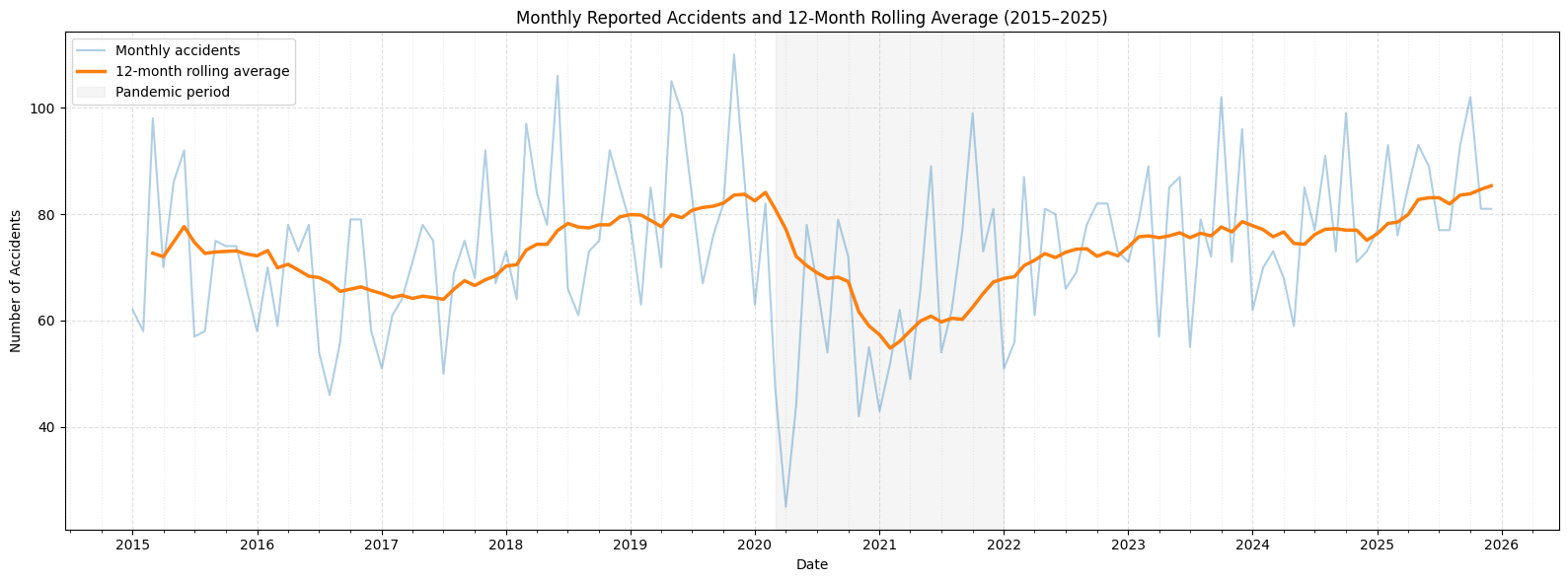
Across the past decade, the data show that accident reporting is not static. Monthly figures fluctuate largely, but the rolling average reveals an explainable structure: a combination of cyclical variation, shock periods, and gradual reconfiguration over time. In Table 1, I have summarized the identifiable patterns from Figure 3. Every reader is welcomed to analyze and interpret the chart on his or her own terms.
Identified Patterns | |
1 | The Geneva public transport network shows persistent monthly volatility, which is typical for population-dense public transport data. |
2 | The 12-month rolling average is essential for interpretation, as it smooths temporary spikes and highlights longer-run movement. |
3 | The period around 2020-2022 likely reflects disruption associated with the pandemic era, altered travel demand, and changing operational conditions. |
4 | The post-2022 recovery period suggests that the network did not simply “return” to its pre-pandemic state, but instead entered a somewhat different operational balance. |
Composition of Accidents
The first inferential question that is of interest to me is whether the relative contribution of electric fixed-infrastructure and bus-based vehicles to reported accidents remained stable across the decade. To test this, I divided the sample into three distinct periods: a pre-pandemic phase (2015-2019), the disruption period associated with the pandemic and its aftermath (2020-2022), and the more recent recovery phase (2023-2025). I then compared the distribution of accidents across the two vehicle groups using a chi-square test of independence.
Period | Bus-based vehicles | Electric fixed vehicles | Total (Absolut) | Electric share |
2015-2019 | 2’617 | 1’728 | 4’345 | 39.8% |
2020-2022 | 1’342 | 964 | 2’306 | 41.8% |
2023-2025 | 1’538 | 1’235 | 2’773 | 44.5% |
Table 2 shows a gradual increase in the share of reported accidents involving electric fixed-infrastructure vehicles. In the first period, these modes accounted for 39.8% of the accidents in the comparison sample. This rose to 41.8% in 2020-2022 and to 44.5% in 2023-2025. Bus-based vehicles continued to account for the majority of accidents throughout, but the relative balance between the two groups shifted over time. The chi-square test confirms that this change is unlikely to be due to random variation alone.
Test | χ² | Df | P-Value |
Period x vehicle group | 15.846 | 2 | 0.00036 |
The result is statistically significant. This means that the composition of accidents between the two vehicle groups did not remain constant across the decade. The relative weight of electric fixed-infrastructure vehicles in the accident record increased over time.
However, this should be interpreted carefully. The test does not show that electrification caused accidents to increase or decrease. Rather, it shows that the distribution of reported accidents changed as Geneva itself changed. In a place where service patterns, route structures, and the modal composition of public transport have evolved over the past decade, such a result is completely plausible. It is consistent with a system in which electric vehicles occupy a larger operational role than they did earlier in the sample, even if their absolute or relative risk is not necessarily higher.
The relation between monthly accidents and the role of vehicle type
To complement the test of independence, I estimate a Poisson regression in which the dependent variable is the monthly figure of reported accidents. Another author’s note here, the purpose of this model is not to infer causal effects, but to test whether one vehicle group is systematically associated with higher (or lower) accident counts once recurring seasonal patterns and a gradual time trend are taken into account.
The model includes three elements: a binary indicator for whether the monthly observation belongs to the electric group (is_electric), a full set of monthly indicators C[T.1-T.12] to capture seasonality, and a linear time trend (time_index) to account for gradual changes over the decade. Because the dependent variable is an absolute number, the Poisson specification is a natural first approximation.
Variable | Coefficient | Std.Error | Z-Stat | P-Value |
Is_Electric | -0.3368 | 0.021 | -16.117 | 0.000 |
Time_Index | 0.0004 | 0.000 | 3.241 | 0.001 |
Observations: 264
Model family: Poisson GLM
Pseudo (CS): 0.7587
Comparison | IRR* | Interpretation |
Electric vs. bus-based vehicles | 0.714 = e-0.3368 | Monthly accident counts are approx. 28.6% lower for electric fixed-infrastructure vehicles |
*In Poisson regression, the IRR is derived by exponentiating the coefficient. IRR < 1 means that the exposure is associated with a lower rate. An IRR of 0.70 means the exposed group has 0.7 times the rate (or 30% lower rate) of events. [2]
Holding constant seasonality and a linear time trend, the monthly number of reported accidents associated with electric fixed-infrastructure vehicles is approximately 28.6% lower than the monthly number associated with bus-based vehicles in the comparison sample. While this is a strong association, but it should be interpreted with caution. The model is based on reported counts, not on exposure-adjusted risk. By way of example, it does not control for passenger volumes, vehicle-kilometers, service frequency, route complexity, or network expansion. For that reason, the coefficient should not be read as evidence that electric vehicles are inherently safer in a causal sense. What it does show is that, within this dataset and under a simple count-data specification, electric fixed-infrastructure vehicles are associated with systematically lower monthly accident counts than bus-based vehicles.
The model also points to a recurring seasonal pattern. Several month indicators are positive and statistically significant, especially in March, May, June, September, October, November, and December. This suggests that the accident process is not temporally constant. Instead, it follows a repeating annual rhythm, likely shaped by the interaction of demand intensity, weather, school calendars, congestion, and network operations.
Discussion of Results
The evidence supports three broad takeaways for Geneva:
1. Accidents are concentrated, not random
A small number of hours, lines, and stops account for a disproportionate share of accidents. That suggests operational complexity is spatially and temporally clustered.
2. Geneva’s accident composition changed over the decade
The chi-square results show that the relative contribution of electric and bus-based vehicles shifted significantly across the decade’s three phases. That is consistent with a transport system that has evolved structurally, not merely fluctuated in place.
3. Electric fixed vehicles are associated with lower monthly accidents
The Poisson model indicates a meaningful association between electric fixed-infrastructure vehicles and lower reported monthly accident counts relative to bus-based vehicles, even after accounting for seasonality and a time trend.
For policy implications and recommendations, Geneva could look more closely at the following points that can be derived from the results:
- route design
- stop design
- traffic separation
- intersection treatment
- operational regularity
- where network complexity accumulates
Conclusion
A decade of Geneva public transport accident data reveals a system shaped by concentration, seasonality, and structural change. At the descriptive level, accidents cluster in recognizable ways: by hour, by line, by stop, and across identifiable periods of the year. At the temporal level, Geneva’s operational profile has evolved rather than remained stable, with the pandemic period and the post-2022 phase standing out as distinct chapters.
At the inferential level, the evidence suggests that electric fixed-infrastructure and bus-based vehicles do not share identical incident patterns. Their relative accident shares shifted significantly over time, their severity distributions differ, and monthly counts are lower for electric vehicles. Public transport systems do not suddenly become safer or dangerous. They evolve over time. And in Geneva, over the past 10 years, that difference is now visible in the data.
Thank You Note
When composing this article, I thought profoundly about my economics master’s classes at HEC Lausanne and especially about one class from Professor Joao Montez. If you, as a dear reader, have the opportunity to take one of his courses, I would warm-heartedly persuade you to do so. It was one of my biggest take-away lessons throughout my studies.
Limitations
Accident counts are not exposure-adjusted. Lines, stops, and service categories with more vehicles, passengers, or service frequency will naturally tend to record more incidents. The analysis therefore captures concentration of reported incidents, not necessarily intrinsic danger.
The electrification comparison is a vehicle-type proxy. For inferential analysis, tramway and trolleybus were grouped as electric fixed-infrastructure vehicles, while bus categories were grouped as bus-based services. This does not imply that every bus service remained fossil-fuel powered throughout the decade, especially as electrification expanded in later years. Categories such as autres, manifestations, notfound, open days cern, personnel, and salon auto were removed from the inferential analysis.
Statistical tests assess association, not causation. Chi-square and Poisson regression indicate whether patterns differ between groups or periods, but they do not establish that electrification itself caused those differences. The Poisson model is intentionally simplified. Monthly incident counts may exhibit overdispersion and may also be influenced by external shocks such as the pandemic, network extensions, service redesigns, or reporting changes. The regression should therefore be interpreted as an exploratory count model. This analysis uses reported incident counts, not exposure-adjusted risk. Lines and stops with more vehicles, passengers, or service frequency will naturally record more incidents. Comparisons therefore indicate concentration and operational burden, not necessarily intrinsic danger. The model estimates differences in reported monthly incident counts between service groups, not exposure-adjusted accident risk.
This data analysis has been conducted in the IDE of GoogleCollab, with Python programming language.
Jennifer-Marieclaire Sturlese
Sources
[0] Coverphoto created with Dall’e
[1] TPG open data platform https://opendata.tpg.ch/explore/
[2] Incident Rate Ratio (Principles of Epidemiology) https://archive.cdc.gov/www_cdc_gov/csels/dsepd/ss1978/lesson3/section5.html#:~:text=That%20is%2C%20a%20rate%20ratio,the%20group%20in%20the%20numerator.