


The habit of engaging with full-length, data-driven journalism has regained importance in an era dominated by fragmented attention and rapid information cycles. Against this backdrop, this article aims to contribute three empirically grounded insights into Swiss voting behavior by drawing on 177 years of federal vote data.

The motivation for this analysis emerged while reading a recent Financial Times article discussing Switzerland’s role as a “real-time indicator” of political sentiment [1]. The argument is straightforward but compelling: in a system of direct democracy, societal preferences surface earlier and more visibly than in representative systems. Issues that elsewhere must pass through party competition, electoral cycles, and legislative filtering are, in Switzerland, brought directly to the electorate. As a result, political and social vibes become observable at an earlier stage, whether related to migration, infrastructure pressure, or European integration. [1]
This perspective resonates with my own academic work at HEC Lausanne, where we examined the effect of bundling referendums on voter turnout using Swiss panel data. Our findings suggested that bundling can increase participation by up to six percentage points. In absolute terms, an effect equivalent to adding the electorate of entire cantons such as Graubünden and Valais. While illustrative, this highlights a broader point: institutional design measurably shapes democratic outcomes. [2]
Building on this foundation, the present analysis leverages the swissvotes.ch dataset (1848 to 2026) [3] to examine long-run patterns in voting behavior. Switzerland is often described as a “laboratory of democracy.” Yet even in a laboratory, not all outcomes are random. Over time, distinct structural regularities emerge across geography, institutional design, and cultural divides. As the next round of national votes approaches, three findings are worth elaborating on in detail.
1. The Rebel Score
One of the most striking patterns in the data is the uneven geographic alignment with national outcomes. By constructing an Alignment Score that measures how often a canton’s majority vote coincides with the national result, we can identify both “representative” and “deviant” regions within the federation. Figure 1 exhibits this rebel score for each canton. The higher the score (x-axis, dissent rate), the more often the individual canton (y-axis, abbrev.) defy the nation result.
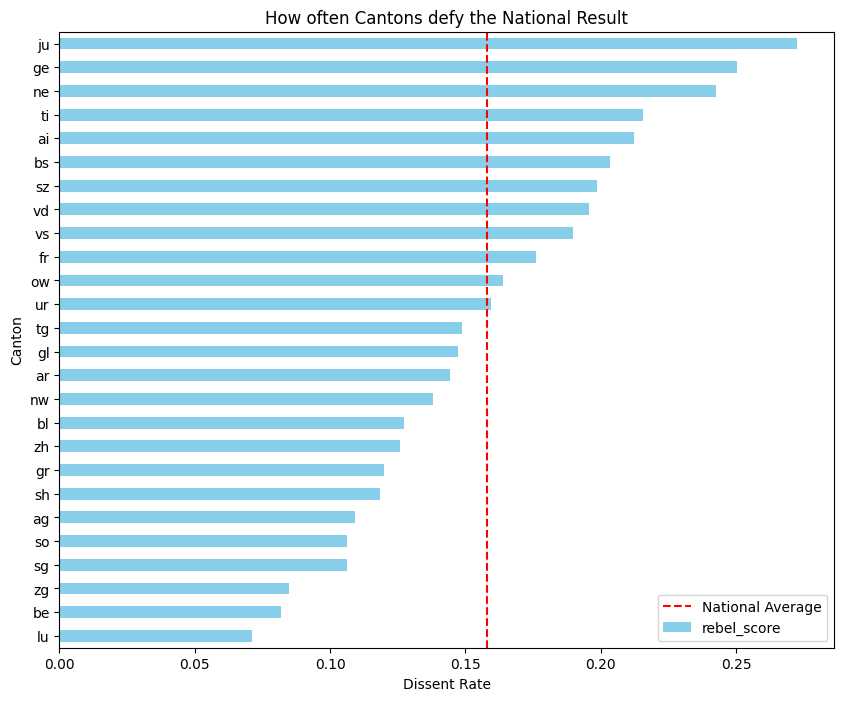
Figure 1: The Rebel Score
At one end of the spectrum lies Lucerne (LU), aligning with the national outcome in approximately 93% of all votes. Bern (BE) follows closely. These cantons can be interpreted as statistical proxies for the national median voter. In other words, what one might call the ‘center of gravity’ of Swiss democracy.
At the other end, a different pattern emerges. Jura (JU), Geneva (GE), and Neuchâtel (NE) exhibit the highest rates of dissent, systematically deviating from national outcomes. Ticino (TI) and Appenzell Innerrhoden (AI) also appear as outliers, albeit for different structural reasons: one former reflecting linguistic and political positioning, the latter a more traditionalist voting profile.
This “rebel ranking” is not merely anecdotal. It reflects persistent structural heterogeneity within Swiss federalism: linguistic, urban-rural, and cultural dimensions all contribute to systematic divergence. The Röstigraben is therefore only one manifestation of a broader pattern of differentiated political behavior.
From a geographic perspective, the existence of systematically “representative” and “deviant” cantons challenges the notion of a uniformly distributed national will. Instead, certain regions approximate the aggregate outcome with high consistency, while others function as persistent contrasts. This does not weaken the democratic process; rather, it highlights the role of federal diversity as an integral feature of collective decision-making.
2. The Institutional Effect
Not all votes are created equally. A central finding of this analysis is that the legal form of a vote is one of the strongest predictors of its success. Using both logistic regression and Bayesian inference, clear probability clusters emerge:
|
Legal Form |
Success Rate |
|
Popular Initiatives |
12% |
|
Optional Referendums |
58% |
|
Mandatory Referendums |
75% |
Table 1: Success rate by legal type
The implication is structurally significant (p-value = 2.577e-49).
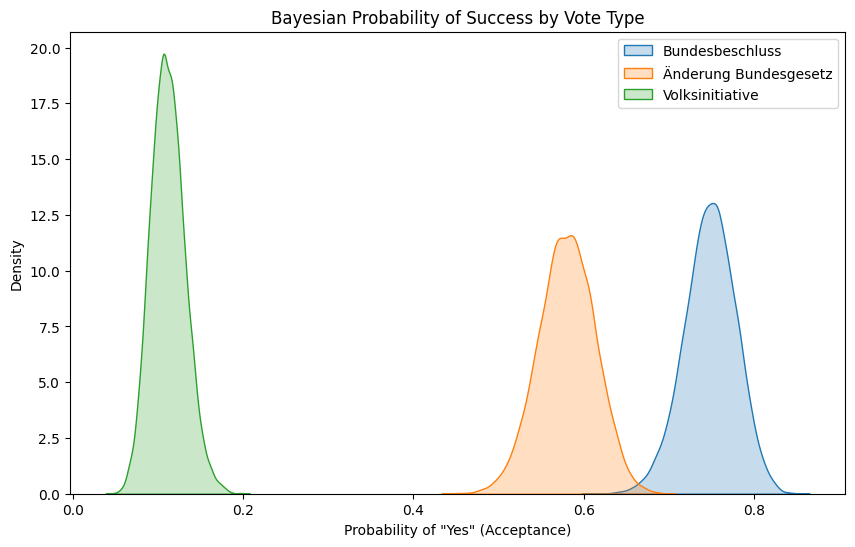
Figure 2: Institutional Effect
In practical terms, this reflects a strong institutional asymmetry. While popular initiatives play a critical role in agenda-setting and public debate, they face substantial statistical barriers to acceptance. In contrast, government-backed proposals, particularly mandatory referendums, benefit from a markedly higher likelihood of approval. From a functional perspective, this can be interpreted as a balancing mechanism. Direct democracy amplifies participation, but institutional filters maintain policy steadiness. In this sense, the system balances openness with stability.
3. The Röstigraben depicted as non-static divide
The linguistic divide between French- and German-speaking Switzerland known as the Röstigraben is often portrayed as a fixed boundary. The data suggests otherwise.
By tracking the difference in average “Yes” vote shares between linguistic regions over time, a clear pattern emerges: the gap fluctuates in waves rather than remaining constant.
In a historical timeline, we can see peaks in polarization are observable around the turn of the 20th century and again during the European integration debates of the 1990s. In recent decades, the gap has stabilized but remains structurally significant, typically ranging between 10 to 15 percentage points. What is important to mention is that the magnitude of the divide depends on the type of vote: it tends to be more pronounced for parliamentary law changes than for popular initiatives.
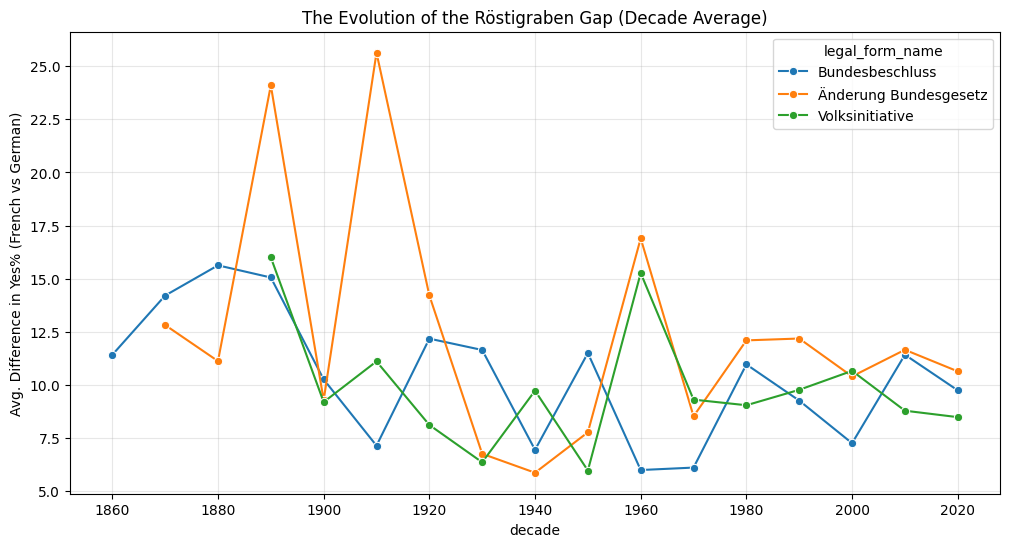
Figure 3: Röstigraben Divide over 177 years
The dynamics of the Röstigraben further illustrate that political divisions in Switzerland are not static but evolve in response to broader societal and international developments. Periods of heightened polarization correlate with moments of structural change, by way of example, industrialization (year 1890), globalization (year 1910), or European integration (year 1960). This finding suggests that the Röstigraben is best understood not as a fixed line, but as a context-sensitive phenomenon as it intensifies when issues touch upon identity, sovereignty, or redistributive policy.
Interpretation of Findings
The empirical findings presented in this article point toward a central insight: Swiss direct democracy, while often perceived as a purely participatory mechanism, exhibits remarkably stable structural regularities over time. These regularities emerge along three dimensions (a) geography (b) institutions, and (c) culture and shape together the observable outcomes of federal votes.
For policymakers, this has practical implications. Anticipating voting outcomes is not merely a matter of polling, but of understanding structural factors: the type of proposal, the regions most likely to align or dissent, and the broader socio-political context in which a vote takes place. For researchers, the results highlight the value of long-run data in uncovering persistent patterns that are not visible in single cycles.
Ultimately, the “will of the people” in Switzerland is neither random nor monolithic. It is a measurable, evolving construct shaped by institutional design, regional diversity, and historical context.
Empirical Analysis
For this analysis, I rely on the publicly available dataset provided by swissvotes.ch, [3] which comprehensively entail all federal referendums and popular votes in Switzerland from 1848 to 2026. To ensure consistency, I restrict the sample to completed votes up to 2025, excluding the ongoing year of 2026. The dataset combines institutional characteristics of each vote with canton-level outcomes, allowing for both cross-cantonal and longitudinal temporal analysis.
The core variables used in this study include:
|
Parameter |
Scale |
Details |
|
Vote outcome |
Nominal 0/1 = No/Yes] |
on national level |
|
Cantonal outcome |
Nominal [0/1 = No/Yes] |
per canton, [cantons’ abbrev] e.g. vd-oui, vd-non … |
|
Legal form |
Nominal |
3 categories:
|
|
Time-axis |
Year |
1848 – 2025 |
|
Dummy Linguistic |
Nominal [German/French] |
Manually coded by majority of spoken language: French = [‘GE’, ‘VD’, ‘NE’, ‘JU’, ‘FR’, ‘VS’] German = [‘ZH’, ‘BE’, ‘LU’, ‘UR’, ‘SZ’, ‘OW’, ‘NW’, ‘GL’, ‘ZG’, ‘SO’, ‘BS’, ‘BL’, ‘SH’, ‘AR’, ‘AI’, ‘SG’, ‘AG’, ‘TG’] |
Table 2: Variables Used for Analysis
(Note: Details on Variables can be found in the Codebook [4] of the SwissVotes Dataset [3].)
The Alignment Score (for Finding 1) captures how frequently a canton’s majority decision coincides with the national outcome, and a language gap measure (for Finding 3), defined as the difference in average approval rates between linguistic regions.
The empirical approach follows a similar philosophy to my previous article [5]: combining descriptive statistics with a limited set of inferential tests that remain robust given the structure of the data. Historical voting data is inherently heterogeneous. Therefore, while acknowledging this major limitation, I stick to foundational comparisons.
First, the descriptive statistics present long-run patterns. This includes canton-level alignment rankings, success rates by legal form, and the evolution of approval gaps between linguistic regions. These findings provide an empirical cornerstone for identifying structural regularities in Swiss voting behavior.
Second, to formally assess differences in success probabilities across legal forms, I estimate a logistic regression model. The dependent variable is binary (approval [yes] vs. rejection [no]). The variable legal form of the vote, complemented by a time trend. The results confirm that institutional design (type of referendum) is a primary determinant of success probabilities.
Third, I compute a Bayesian estimation of success rates with Beta-Binomials. This is particularly useful given the varying number of observations across vote types. By assuming a non-informative prior, the posterior distributions provide intuitive probability estimates and highlight the degree of uncertainty associated with each legal form. The resulting distributions reveal clearly separated “probability regimes” across initiatives, optional referendums, and mandatory referendums.
To analyze the Röstigraben divide, I construct a time series of linguistic voting gaps, defined as the absolute difference in average approval shares between French- and German-speaking cantons. A rolling average is applied to smooth short-term volatility and emphasize long-term dynamics.
An author’s note is warranted here and extensively elaborated in the limitations section: the methods employed are not designed to establish causal relationships. Rather, they provide a structured and empirically grounded way to uncover persistent patterns, quantify institutional effects, and track the evolution of political divides over time.
Conclusion
Taken together, these findings offer an empirically-backed interpretation of Swiss direct democracy:
|
Finding |
Key-Takeaway |
Details |
|
1 |
Geographic regularities persist |
Certain cantons systematically reflect (or diverge from) national outcomes. |
|
2 |
Institutional design matters |
The probability of success is strongly conditioned by the legal form of the vote. |
|
3 |
Cultural divides are non-static |
The Röstigraben evolves in response to economic context, predominantly seen by diverges relating to industrialization (year 1890), globalization (year 1910), and European integration (year 1960). |
The essence synthesizes in the “will of the people” is not a random aggregation of preferences, but a patterned outcome shaped by geography, institutions, and time. Switzerland may indeed function as a laboratory of democracy but one in which the underlying mechanisms are, increasingly, empirically observable.
Limitations to this Empirical Analysis
First, the results are based on aggregated voting outcomes, not on individual-level data. As such, the analysis captures patterns at the canton and national level but cannot account for voter heterogeneity, turnout composition, or micro-level behavioral mechanisms. Differences in participation rates across regions or vote types may therefore influence the observed outcomes.
Second, the classification by legal form (popular initiative, optional referendum, mandatory referendum) serves as a proxy for institutional context, but it abstracts from substantive differences in policy content. Certain topics (e.g. European integration, migration, or social welfare) may systematically affect approval probabilities, independent of legal structure. The estimated “institutional effect” should therefore be interpreted as a dominant, but not exclusive, driver.
Third, the linguistic grouping of cantons simplifies a more complex cultural and political landscape. While the French-German divide provides a useful approximation for analyzing the Röstigraben, it does not fully capture intra-regional variation, bilingual cantons, or urban-rural cleavages that may interact with language effects.
Fourth, the time-series dimension introduces structural heterogeneity. Over a period spanning 177 years, Switzerland has undergone substantial institutional, economic, and societal changes. Although smoothing techniques (i.e. rolling averages) mitigate short-term volatility, long-run comparisons remain sensitive to historical context and should not be interpreted as fully stationary processes.
Finally, the applied statistical methods (i.e. logistic regression and Bayesian estimation) are designed to identify associations rather than causal relationships. While the models quantify systematic differences in success probabilities and voting patterns, they do not establish that institutional design or geography causes these outcomes. The results should therefore be interpreted as an empirical characterization of patterns, not as causal inference.
Final Remarks
This data analysis has been conducted in the IDE of GoogleCollab, with Python programming language, 3.12 kernel. The full code (notebook) is available on my GitHub repository [6].
Jennifer-Marieclaire Sturlese
Sources:
- [0] Cover Photo created with Dall’e
- [1] Financial Times article
- [2] Economic Communication Team Project, Winter semester 2022, under guidance of Prof. Joao Montez (analysis available upon request)
- [3] Swiss Votes Dataset
- [4] Swiss Votes Codebook
- [5] 10 Years of Geneva Public Transport Accident Data. A Statistical Analysis.
- [6] My Github Repository for the analysis
Similar articles:
10 Years of Geneva Public Transport Accident Data a Statistical Analysis

Digital Signatures and the Interoperability of EU E-Government
