

First Words
As with any modern commodity, video games too are affected by the shift away from ownership and towards recurrent payment models, so much so that almost every large studio and publisher would love to have a Live Service title in their repertoire. Not only does a good, well-maintained live service game constitute a steady stream of cash, which is important for an endeavor as costly as developing a video game, but it also binds players in highly dedicated communities, which means they don’t have much time to play other games and cannot spend their money on the competition’s products.
Recurring Issues
Among the largest of the large players in the pool, most have a well-established Live Service game, such as Epic Games with Fortnite, Rockstar with GTA 5 or Valve with their early access title Deadlock; however, one company cannot get their hands on this prized possession. Out of all the large enterprises, it is Sony, who have tried and failed time and time again to launch and maintain a good live service game. With the release of the highly anticipated extraction shooter Marathon, developed by Sony-subsidiary Bungie, the question flares up yet again: Why can’t Sony make a good live service?
To keep a Game Alive
The traditional life cycle of a video game follows a simple pattern: find funding, develop the game, release the game, pay the bills, and develop a new game. By modern standards, this model seems almost archaic; it is very risky and people can lose a lot of money if something goes wrong, which is why studios in the early 2000s started iterating and innovating by trying to solve this one question: How can we continuously extract funds from our player base over time?
In the beginning, this was a pragmatic creative question of course. Development of Massive Multiplayer Online Role-Playing Games, also called MMORPGs for short, was costly and time-intensive and couldn’t be covered with the revenue from a one-time purchase, which is how the controversial subscription model was put into place.
Instead of buying a game once, and owning it forever after, the players would pay $11.99 each month to continue playing, which gave the devs funding to continuously develop and release updates for the game. Two games which successfully implemented this model and are still kicking today were RuneScape and World of Warcraft.
The Modern Model
With the success of The Elder Scrolls: Oblivion came the advent of cosmetic microtransactions, shortly after Bethesda released the Horse Armor Pack for $2.99, which included a purely cosmetic armor set to customize an in-game horse. Over the course of the following years, this monetization model of selling in-game cosmetics to fund continued development would gain a noticeable foothold in the industry, as more and more titles became free to play while employing this strategy.
The industry finally reached its peak in terms of predatory monetization mechanics when gacha-mechanisms called loot boxes became commonplace. These mechanics let players pay real money to acquire boxes containing random in-game cosmetics or, even worse, objective power increases, which ultimately led to legislation in various countries banning the practice. These loot boxes were first perpetuated by Overwatch and later abused by Star Wars Battlefront 2 to the point where the game was abandoned by its player base.
The solution to replace this notorious system was the Battle Pass introduced by Fortnite, where players purchase the right to progressively acquire certain in-game cosmetics during a limited timeframe, which non-battle-pass-holders are barred from. Even though both of these mechanics are heavily frowned upon and the Battle Pass is generally considered the lesser evil, studios and publishers drool over live service games that employ one of or both of those monetization models, because they are highly profitable.
Graveyard of Ideas
As an immensely successful multimedia conglomerate, it makes virtually no sense that Sony and interchangeably PlayStation cannot for the life of them sustain a live service. Over the last decade, out of 18 announced live service games, half of them were cancelled; four are still in development and only five have been released.
The most notable examples include a Spiderman spin-off by Insomniac Games, a The Last of Us Multiplayer game by Naughty Dog and a God of War live service developed by Bluepoint, which subsequently had to close its doors. The latter example is among the most egregious cases of mismanagement, because Bluepoint had been acquired by Playstation in September 2021 and was touted as a great supporting studio, but ended up getting shuttered by PlayStation itself just five years after their acquisition.
A Terrible Task Manager
Bluepoint specialized in remastering and compiling video games and porting them to different consoles, but assigning this studio the task of developing a live-service God of War title—which in itself is already nonsensical, given that all God of War games were single-player experiences relying on a highly limited number of playable characters—was essentially like trying to teach a fish how to walk. However ridiculous the project was from an IP standpoint, a studio like Bluepoint was never going to be any good developing a live service, and when they inevitably failed, they were shut down.
The Worst Possible Launch
This story is a tragic one, but doesn’t hold a candle to Concord, THE stain on Sony’s resume. Announced in 2023, launched in 2024 and shut down just two weeks after launch with all copies refunded and an all-time concurrent player peak of 697 players, Concord showed that something had to be wrong with whoever makes the decisions at PlayStation.
The game was supposed to be a science-fiction live service hero shooter, which is nothing new in an oversaturated market, while also suffering from lackluster character design, few and confusing ad campaigns, and a hefty $40 price tag for an online-only game that does essentially what Overwatch does for free.
After its disastrous launch, mass layoffs followed and the studio was closed, as seems usual procedure under Sony at this point. However, there may be hope that not all is lost for Playstation and their coveted elusive live service, even though one might argue that Sony doesn’t even need a live service game, since their most critically acclaimed Playstation exclusives like Ghost of Yotei and God of War Ragnarök are all highly profitable single-player experiences.
What does the future hold?
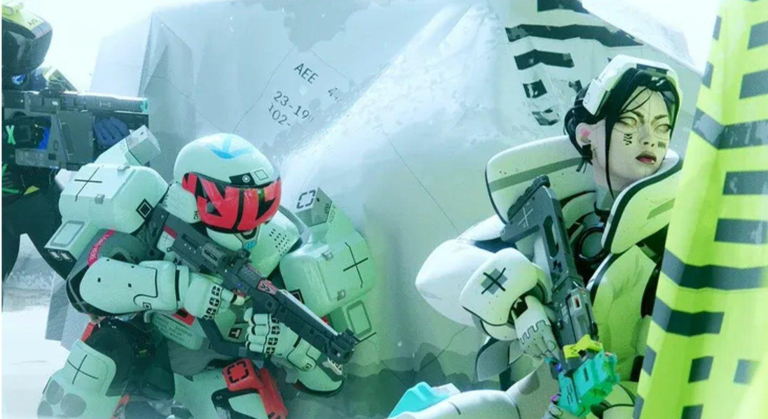
On March 5th, 2026, Marathon released. Developed by Playstation-subsidiary Bungie, the same studio that made classics like Halo 3 and Destiny, this new title marks the first new entry into the Marathon series that had been a Bungie IP since the 90s, with the last of three games, Marathon Infinity, released in 1996. This new game is an extraction shooter set in a distant future where teams compete for resources and try to escape with the most loot possible, which is in and of itself nothing new but also no source of concern. However, it is once again in management where the cracks start to show again.
Familiar Woes
Just like Concord, Marathon suffered from little advertisement and hype, a $40 price tag, online-only gameplay and no single-player campaign. Even worse, heavy allegations of plagiarism surfaced as more and more of the game’s content was showcased in the lead-up to its release. Although this dispute has since been resolved with the artist giving their consent for the developers to use the likeness of their art, assets had been lifted and directly implemented in the game without prior permission, which constitutes a new low for a AAA studio as renowned as Bungie.
Marathon’s current all-time concurrent player numbers peaked immediately after the game’s launch at 88,337, with numbers settling between 35,000 and 75,000 concurrent players. This is by no means indicative of the game’s quality but more so of its management – Destiny 2, the last previous release of the studio, launched to 1.2 million concurrent players on Xbox and Playstation alone with a PC release following later on, which was only possible through extensive marketing, a ready single-player and co-op campaign as well as multiplayer options.
Interna l Restructuring
Now, those glory days are long gone and Destiny 2 has seen a sharp decline in its player numbers, as expansions grow more and more iterative and lackluster, which can all be traced back to mismanagement again. Over the last years, the development of Marathon necessitated an immense amount of manpower, which resulted in developers being reassigned from Destiny 2, which in turn negatively impacted the quality of this live service, increasing the financial pressure on the studio, and ultimately leading to mass layoffs. On a side note, former Bungie CEO Pete Parsons, who stepped down in 2025, even expanded his collection of classic cars while firing 8% of the studio’s employees, which equals around 100 developers.
As for the future of Marathon and Bungie, the market for live-service games and hero shooters is oversaturated; the game is very inaccessible for a live service because of its $40 price tag, and the lack of promotion and hype prior to its release severely hampered its peak player numbers. But if a steadily motivated community builds and stays around Marathon, it is very well possible for this game to sustain itself for years to come.
It will never become the fabled cash cow live service Playstation desired and barred itself from having through bad management for so many years already. And even worse, why put all those hopes and expectations into a new game from a buried IP while the studio has to juggle their main project alongside and avoid the red digits? From Sony’s perspective, it would have been easier to invest into the development of a possible Destiny 3, which has an established and dedicated player base, rather than taking a shot in the dark with Marathon, since they acquired Bungie in 2022 for 3.6 billion dollars, believing that Bungie could finally give them the live service they so desired.
Last Words
Repeat what Sony did wrong: it was the mismanagement, why they did it wrong, and why that’s a problem, alongside the divination of possible industry trends in an oversaturated market. Following the success of the MOBAs, MMORPGs and Battle Royales of the 2000s and the 2010s, many companies tried to replicate this model to get a share of the pie, but none failed as miserably as Sony. Over the years, Sony has acquired and shuttered studios, announced and cancelled projects, and laid off enough devs to make every live service they ever wanted, which is a worrying track record for a company of this size with the aspiration to make profitable games.
What often appears to be a shortcoming of the studio turns out to be mismanagement from Sony in the background, which is quickly denied and fixed by firing everyone and closing the studio. Like a long-distance run, a successful live service requires careful prior planning and development accompanied by continued funding and support after launch; it’s about endurance, not pushing it all out on launch day.
Even though Bungie’s new game Marathon did not launch as terribly as many anticipated, it is still far from fulfilling its role as Sony’s prized live service. The only bright spot in this dilemma is the staggering amount of critically acclaimed single-player experiences launching as Playstation exclusives.
Even though Bungie’s new game Marathon did not launch terribly as many a nticipated, it is still far from fulfilling its role as Sony’s prized live service. The only bright spot in this di lemma isthe staggering amount of critically acclaimed single -player experiences launching as Playstation exclusives.
Domenic Schwander
Sources :
– Steamdb.info
– Forbes /The ‘Marathon ’ Day One Ste am Player Count Is A Bit Concerning
– Marathon Art Controversy Resolved As Artist Reaches Agreement With Bungie And
Sony
– Popularity .report
– Sony Is Losing Confidence In Bungie & Marathon
Similar articles:

Orcish or English? – How Fantasy tropes Reinforce Colonial Biases

Under the Sea no one hears you Scream
