


Witnessing war has never been easier. One scroll exposes bombed buildings and graphic images of human victims, while one click allows you to turn it all off. New media has changed the way we see armed conflicts and how we engage in conversations about them. While before everyone had access to the same set of news delivered by traditional media outlets like television or newspapers, the digital era brought social media algorithms that curate personalized angles on conflicts. This article aims to observe the particularities of new media and the consequences of its stream of information. As social media reshapes the media landscape covering war, staying informed is necessary but comes at a heavy cost.
Mechanisms of Action of New Media
War being addressed online is not new. The 2011 Syrian war was one of the first armed conflicts to be documented online, but it does not compare to today’s informational stream about the wars in Ukraine, Gaza, or recently in Iran that are easily accessed on social media giants such as Instagram or TikTok. The major difference between these social media platforms and traditional outlets is that the former are personalized, meant to create emotional reactions, and thus, to make war content addictive.
Social media produces an enormous amount of content related to world events at lightspeed, and you guessed it: you only see the few that your algorithm decides are “for you.” The latter implies that you will only be given a specific side of an armed conflict based on your previous personal experience on the social platform, but also, that even if you ultimately choose to scroll to the next video, you cannot choose what that next video will be. You can be confronted with benign content as much as with graphic violent war images within seconds. This means that even if you did not mean to engage with such content, you can be introduced to it by social media. This point can be positive as it might give a larger audience awareness of armed conflicts and humanitarian crises around the world. The downside is that it often creates an endless and hard-to-disengage-from spiral of extremely violent content, both for clueless users and for those who initially meant to look for genuine information about armed conflicts. If you happen to engage with a video about a conflict, you can be sure that you will be flooded with further content on the subject.
The quality of the personalised spiralling content is also a main factor to consider. More than being presented with graphic images, social media tends to also spread misinformation that regularly generates higher content engagement. The culture website Input investigation quoted by Time reveals how, during the current war in Ukraine, “on-the-ground” posts from supposedly Ukrainian journalists were in fact fabricated miles away from the armed conflict. Marek Górka’s article on “Social Media as the Dimension of Contemporary War: Analysis of the Conflict in the Gaza Strip after October 7, 2023” found current online war videos to be old content reused from 2013 and 2016 conflicts. Such misleading content may originate from metrics-driven creators as much as from state-sponsored online propaganda programs, both upholding a specific ideology. This point is even more relevant with mainstream access to artificial intelligence that creates hyper-realistic deepfake videos.
These issues are emphasized by the lack of moderation on current social media platforms. Most of the latter do not disclose their moderation process, but from the content available it appears to be a relatively mild form of control. This point also differs from traditional media that would select appropriate content for an all-age public, or at least give a warning when diffusing content for mature audiences.
The Impact of Scrolling through War
This specific algorithmic system has multiple heavy consequences on our mental health, our society, and our perception of the world.
Professor of psychological science at the University of California Roxane Cohen Silver quoted by Time, argues how the amount of content and the extent of violence in it directly affects our mental health. As explained, the problem is that social media platforms are meant for delivering a lot of information without any regulation. Users risk becoming trapped in the news cycle of their feed and tracking events up-to-the-minute. This is even more intensified for groups that are directly touched by armed conflicts. Seeing the horrors of war so close, but so far, leads, as Cohen Silver argues, to anxious behaviours or even symptoms of post-traumatic stress disorder (PTSD), and to an even greater degree for individuals already suffering from anxiety.
Regarding the amount of misinformation available, it may also provoke emotional distress for users. They become overwhelmed by the amount of both genuine and false information or images. Unable to distinguish between them, the user’s mental health is impacted as they progressively lose sense of truth and reality.
Misleading content also creates a situation in which the spectator becomes vulnerable to accepting and propagating false information due to the amount and rapidity of the content creating informational fatigue. The following figure, established by the International Review of the Red Cross in their excellent article titled “How harmful information on social media impacts people affected by armed conflict: A typology of harms,” illustrates this point:
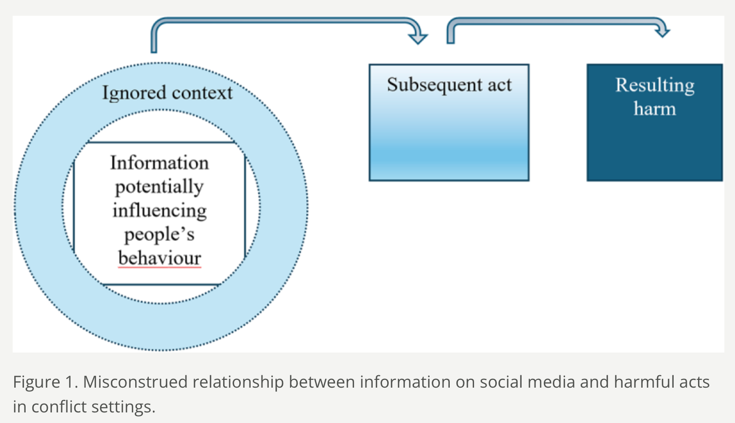
With informational fatigue, users being presented with influential misleading content about armed conflicts on social media, become unaware of any implicit context. As Iranian American New York Times writer Nick Mafi aptly puts it: “the scroll cannot tell a complicated story, only move you past it.” This leads to actions based on biases, which ultimately causes harm as much online as in real-life contexts.
Marek Górka furthers this point by highlighting how this creates polarization. Social media does not aim to create public debate, but rather to fuel anger. Górka argues how today the “battle for public opinion is more intense than ever” as “both sides of the conflict are trying to convey their version of events.” This point leaves long-term consequences for the “watching” society with the erosion of trust in truth. It also negatively impacts those who are living in an armed conflict as it lowers conflict resolution prospects, imposes a specific narrative that limits their eyewitness voice, and reinforces group stigmatization and discrimination.
Moreover, the new media approach to presenting war, through large amounts of information and graphic images, can lead to desensitization. The Psychiatric Times describes this phenomenon as users being “exposed to violent or emotionally charged online content [who] develop patterns of emotional numbing, irritability, and difficulty disengaging.” When each scroll reveals large amounts of tragic news and images, the users become used to seeing horrors to the point that it becomes banal, decreasing empathy for the situation. This latter point is also emphasized by misleading information that may belittle tragic event and as argued, create stigmatization towards certain groups involved in armed conflicts. This desensitization process can also come from a feeling of hopelessness. Users are so saturated by tragic news that they start believing that talking and trying to help is a waste of time. It may also derive from a protective mechanism to avoid having to deal with the fact that the graphic images of bombings and dead bodies are real, the latter creating a context for further spiral scrolling to avoid being confronted with that harsh reality.
Conclusion
New media offers a direct lens into war for its own profit and to the user’s detriment. This new accessibility comes with heavy consequences that the user is forced to face. It is a fine line to navigate between educational content about current armed conflicts and impactful images that may affect our health and society as a whole. It is, in fact, only one swipe away. This should not be motivation for deciding to stay uninformed, which also perpetuates harm, but rather to reimagine our way of looking at information about such an important topic as war. We must not forget that behind this simple three-lettered word is a degree of pain and cruelty that no article, no picture, and no video will ever be able to convey. It is a subject that must be treated with respect, not with perfectly curated infinite feeds or total withdrawal, but with an attentive critical eye that goes beyond the limits of a screen.
Carolina Silva Pereira
Sources
The War You Can Scroll On By, New York Times.
Watching War Unfold on Social Media Affects Your Mental Health, Time.
The Empathy Crisis: How Social Media Algorithms Drive Emotional Numbing, Psychiatric Times.
Similar articles:
‘Feeling’ the Truth: The Post-Truth Era and Anti-Intellectualism

Media Access Change in the White House: A New Political Media Landscape
